
Sidewalks Vs. Roots - How to Deal with Roots Pushing Up Sidewalks
Root Pruning
Roots and Sidewalks
Sometimes tree roots push up sidewalks. In the past, when Urban Forestry wasn't a thing and cities barely had policies regarding sidewalks, people planted trees that were too large in planting strips that weren't wide enough to accommodate them. Now we have giant trees that push up sidewalks. Those giant trees are a major characteristic of what makes Coeur d'Alene so beautiful, and our citizens do not want to change that. We now have rules on what-sized trees should be placed where, but in the meantime, we need to deal with roots breaking up sidewalks. We do not want to remove large trees from the streetscape unless they are SUBSTANTIALLY creating infrastructure problems that don't have alternative means of correcting them. This page helps answer some of those questions.
Proper Planting and Watering Techniques
The best way to avoid problems with sidewalks is to prevent them from the beginning in the first place. Certain species tend to have surface roots more than others, so research before choosing a tree to plant is essential. But more important than that is watering the tree the right way, especially for its first few years of life. For more information, click the following link:
Options
If the tree is already established and is lifting the sidewalk, there are several things you can do. Removing a tree is the last option once all the others have been explored or attempted.
Alternative Sidewalk Routing
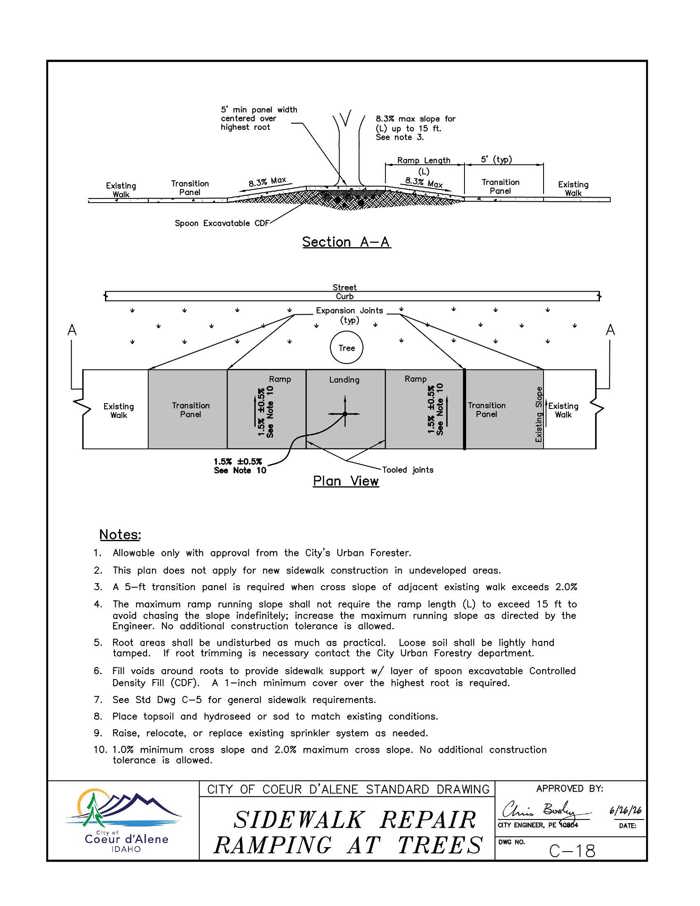
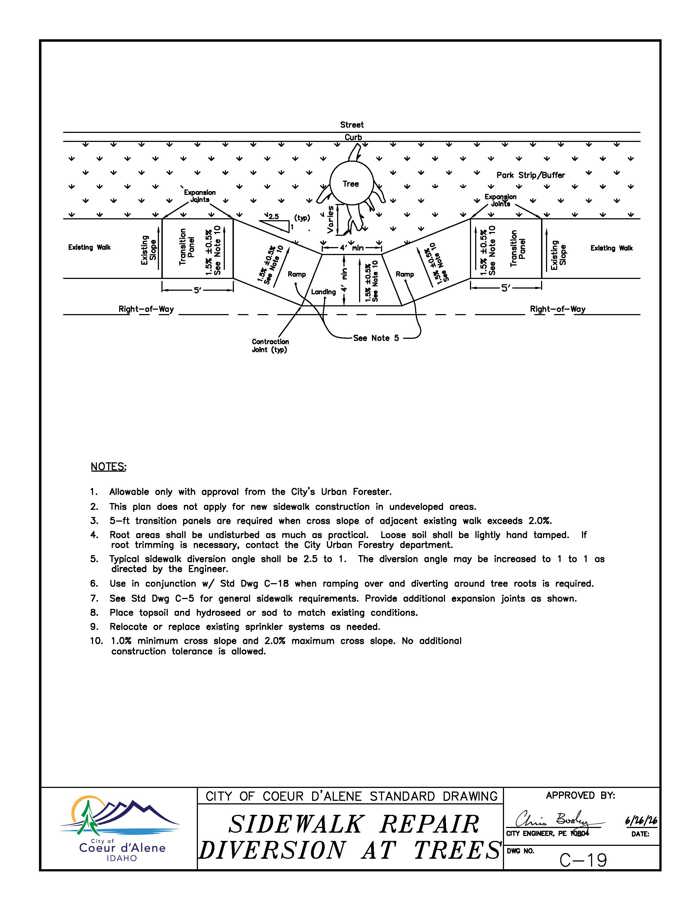
Where possible, rebuilding or rerouting the sidewalk either up and over the roots or around the roots is permitted by city ordinance.
Up and Over
 Around
 Root Pruning
If you aren't able to go up and over or around, you can prune the roots of the tree before replacing the sidewalk, but care must be taken to prevent weakening the structure of the tree. A City-Licensed Tree Service is required to perform root pruning on right-of-way trees.
First, contact the City Urban Forester to get a permit for root pruning. It is free and important to get the information to do it right.
To properly prune roots that are damaging infrastructure, an arborist needs to perform a tree risk assessment first, then expose the roots carefully without tearing them, and make clean cuts on smaller roots while avoiding large structural anchorage roots. Cutting major roots can reduce wind stability and tree vigor, so consider alternatives like bridging, root barriers, or trenchless utility repair when root conflicts are severe.
Pre-Pruning Assessment and Planning
Assess stability and risk: Evaluate tree health, species tolerance, lean, and wind exposure before severing roots. Avoid root pruning on already declining trees or when cuts would compromise primary anchorage.
Respect setback distances: Keep cuts as far from the trunk as practical—many arboricultural guidelines recommend staying outside the root plate or at least 3 to 5+ times the trunk diameter away from the trunk.
Excavation and Root Size Guidelines
Expose roots gently: Use hand tools, an air spade, or hydro-excavation to uncover roots so you can see junctions and avoid ripping bark. Standard practice is that roots under 1 inch are generally straightforward to cut with hand tools, while cuts on roots over 3 inches should be avoided whenever possible.
Follow strict size limits: Prune smaller roots cleanly and stop when encountering larger structural roots (such as 2.5 inches or larger) so stability is not undermined.
Preventative trenching: For recurring sidewalk edges, use a sharp spade along the edge to sever small roots and prevent re-grafting.
Making Clean Cuts and Post-Care
Use sharp tools: Cut cleanly with a sharp saw, pruning shears, or loppers rather than pulling or shredding roots with dull blades or heavy machinery. Cut just beyond lateral junctions or sinker roots where appropriate.
Protect exposed roots from drying: Keep exposed roots covered and moist (such as with damp burlap or a hydrated gel) if left uncovered, and backfill with quality soil once work is complete.
Water and monitor
Soak the root zone thoroughly after backfilling and monitor the tree for stress, lean, or canopy decline over subsequent seasons. Solid concrete is rarely pushed up without pre-existing gaps or soil movement, making proper site and soil evaluation essential.
More options
Opening times
Mon — Fri 9am — 10pm
Saturday 8am — 1pm
Sunday 10am — 6pm