
How To Prevent Surface Roots
Proper Planting and Watering Techniques
Proper planting and watering techniques will help reduce surface roots that are difficult to mow around and can damage and lift sidewalks. Both correct planting and proper watering techniques play vital roles in preventing surface roots, but watering habits have a much greater day-to-day influence on whether roots stay deep or crawl to the top.
How Planting Correctly Sets the Stage
Burying the root flare is a fatal planting mistake that forces roots to stay shallow. If you plant a tree too deep or pile dirt over the root flare (where the trunk widens at the base), the lower roots suffocate from lack of oxygen and new, shallow roots form closer to the surface where air is available.
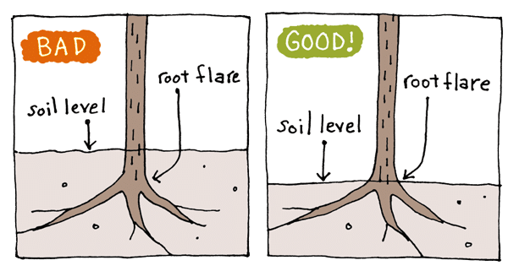
Digging a wide, shallow hole when you plant (rather than a narrow, deep "post-hole") allows loose, oxygen-rich native soil to spread out horizontally. This encourages the structural roots to fan out broadly rather than circling or turning upward out of dense, un-dug clay.
Genetic predisposition also matters. Some trees (like maples and willows) naturally produce more surface roots than others, no matter how perfectly you water or plant them.
How Watering Drives Surface Roots
Shallow, frequent watering teaches roots they do not need to dig deep. When you give a tree a tiny sprinkle every day, only the top few inches of soil stay moist. Roots naturally follow the water and grow upward into that surface zone.
Deep, infrequent watering forces roots to chase moisture downward. Soaking the soil thoroughly (reaching 12 to 18 inches deep) and then letting the top few inches dry out encourages the root system to plunge deeper into the ground for survival.
To truly train a tree's roots to grow downward, you should aim for a deep and infrequent cycle based on the tree's maturity:
1. For Newly Planted Trees (First 1–2 Years)
Young trees have a limited, shallow root ball and cannot handle long periods of drought yet.
The Strategy: Instead of setting your irrigation to water every day, transition to watering 2 to 3 times a week during the hot season.
The Execution: Run the irrigation long enough so that the water penetrates 12 inches deep into the soil. You can check this by pushing a long screwdriver or soil probe into the dirt; it will slide easily through wet soil and stop when it hits dry earth.
This will also help your grass to be healthier!
2. For Established Trees (3+ Years)
Once a tree is established, its root system is expansive enough to tolerate dry surface soil.
*Note – You will still need to keep your irrigation on the cycle mentioned above to keep your grass alive, but add deep soaking once or twice per month with a hose or drip line at the base of each tree:
The Strategy: Increase the runtime even more but drop the frequency to once every 7 to 14 days (or even once a month for certain drought-tolerant species).
The Execution: Soak the area thoroughly around the "drip line" (the perimeter of the tree's outermost branches) so moisture reaches a depth of 18 to 24 inches.
How to Adjust Without Shocking the Tree
If your tree is used to daily shallow water, its root system is currently shallow and fragile. Do not switch to a 10-day restriction overnight.
Week 1-2: Move from daily watering to every other day, doubling the runtime as you suggested.
Week 3-4: Stretch it to every third day, adding a bit more runtime if the soil probe shows the water isn't reaching 12 inches deep.
Week 5+: Gradually stretch the gap to twice a week, monitoring the tree for any signs of wilting or stress.
Grass and Trees
Just like trees, turfgrass suffers from daily, shallow watering. Giving your lawn a quick sprinkle every day or two forces the grass roots to stay in the top couple inches of soil, making the lawn highly sensitive to heatwaves and drought. When you shift to watering every third day and apply a larger volume of water at once, you are applying the same "deep and infrequent" principle to your turf. Here is what happens to your grass:
Deeper Lawn Roots: The water penetrates deeper into the soil. The grass roots will actively grow downward to reach that moisture pocket, creating a much tougher, more drought-resistant lawn.
Less Disease and Thatch: Constantly wet surface soil encourages fungal lawn diseases, mushrooms, and heavy thatch buildup. Letting the top layer of soil dry out briefly between cycles breaks the moisture loop that fungi thrive on.
The "One-Inch" Rule: Most established lawns thrive on about 1 to 1.5 inches of water per week. Watering every third day (about twice a week) for a longer duration is the perfect cadence to deliver this amount without drowning the soil.
The Conflict: Lawns vs. Trees
While every third day is fantastic for grass, keep in mind that lawn irrigation systems are inherently bad for mature trees.
Even on a 3-day schedule, a lawn sprinkler usually only wets the top 6 inches of soil. A mature tree needs moisture that penetrates 18 to 24 inches deep. If your tree relies only on the lawn sprinklers, its roots will still crawl to the surface to steal the grass’ water.
To keep both happy, keep your lawn on the 3-day schedule, but supplement your tree by giving it a slow, deep soak with a garden hose or drip line once or twice a month during the summer.
Deep Soaking Your Trees
To get a proper deep soak using a hose trickle, you should let the hose run for 30 to 60 minutes per location, moving it to 2 to 4 different spots around the tree. This brings the total watering time to about 1 to 4 hours total per tree, depending on the size of the tree.
Because a single hose point only wets a narrow column of soil, leaving it in just one spot leaves the rest of the root system completely dry.
Step-by-Step Trickle Method
Set the Flow: Turn your spigot on until the hose is at a heavy trickle or low flow (just fast enough that the water flows out smoothly but doesn't spray or erode the soil).
Find the Placement: Do not place the hose right against the trunk. Place it at the drip line (the perimeter underneath the outermost tips of the branches) where the active, water-absorbing roots are located.
The Four Corners Method: Imagine a clock around your tree. Place the hose at 12 o'clock and let it trickle for 30–45 minutes. Then, move it to 3 o'clock, 6 o'clock, and 9 o'clock for the same amount of time.
How to Know When It’s Done
The standard rule of thumb is to deliver 10 gallons of water for every 1 inch of trunk diameter.
The Bucket Test: To find out exactly how much water your trickle is delivering, time how long it takes your hose trickle to fill a 5-gallon bucket. If it takes 10 minutes to fill the bucket, your hose flows at 0.5 gallons per minute.
The Screwdriver Test: Once you are finished watering, push a long screwdriver or metal probe straight down into the soil. It will slide easily through the wet soil and hit a "wall" when it reaches dry dirt. If it slides down 12 to 18 inches deep with ease, you have achieved a perfect deep soak.